2 Best RAL Color Charts for 2026 (Find Perfect Shades)
You’ll love the RAL D2 Color Chart with 1,825 semi-matte swatches across 40 smart palettes—perfect for finding exact matches. Pair it with the RAL Color Reader for 92% accurate, on-site measurements using Bluetooth and app integration.
You get durable, archival-grade swatches in a rugged fan deck, labeled in five languages. Match finishes to real-world conditions and share data seamlessly with design tools.
Your workflow just got smarter—and there’s more to discover about optimizing every shade choice.


Quick Overview
- The RAL D2 Color Chart offers 1,825 semi-matte swatches in 40 curated palettes for precise shade selection.
- Swatches measure 2.5 × 5 cm with 7-digit codes and names, ideal for accurate on-site color matching.
- Durable 2.4-pound fan deck with an embossed protective box ensures longevity in professional environments.
- RAL Color Reader pairs via Bluetooth to app, providing 92% accurate readings in CIE Lab, RGB, Hex, and CMYK.
- Multi-language labels and digital integration support seamless collaboration across global design and build teams.
| RAL D2 Color Chart 1,825 Colors Semi-Matte 5 Languages | 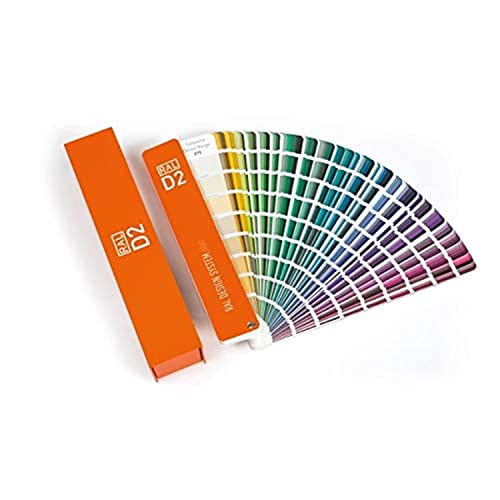 | Essential Reference | Color System: RAL DESIGN SYSTEM plus | Color Identification: 7-digit RAL code plus color name | Application Area: Architecture, industry, design | VIEW LATEST PRICE | Read Our Analysis |
| RAL Color Reader: Professional Color Measuring Device – handy and precise |  | Pro Measurement Tool | Color System: RAL CLASSIC, RAL EFFECT, RAL DESIGN SYSTEM | Color Identification: Determines corresponding RAL colors | Application Area: Architecture, industry, craft | VIEW LATEST PRICE | Read Our Analysis |
More Details on Our Top Picks
RAL D2 Color Chart 1,825 Colors Semi-Matte 5 Languages
If you’re a designer or architect who values precision and broad color selection, the RAL D2 Color Chart is your go-to tool—its 1,825 semi-matte swatches in 40 curated palettes make it easy to find and match exact hues. You’ll appreciate the 7-digit RAL code and name on each 2.5 × 5 cm swatch, with labels in five languages including English, German, and French.
The fan deck fits neatly in your bag at 29 × 5 cm, and its durable, embossed box protects the pages. Lightweight at just 2.4 pounds, it’s ideal for studio or site use.
No batteries needed—just open and choose with confidence.- Color System:RAL DESIGN SYSTEM plus
- Color Identification:7-digit RAL code plus color name
- Application Area:Architecture, industry, design
- Portability:Fan deck with compact box (29 × 5 cm)
- Language Support:5 languages (including English, German, French)
- Digital Integration:None specified
- Additional Feature:225 color pages included
- Additional Feature:High-quality embossed storage box
- Additional Feature:40-color wheel organization
RAL Color Reader: Professional Color Measuring Device – handy and precise
Choosing RAL Color Charts for 2026 means getting precise, real-world color matching with the RAL Color Reader — a handheld device designed for architects, industrial designers, and craftsmen who need accurate color identification on site. You measure colors with 92% accuracy using its 6 high-CRI white LEDs and 45°/0° geometry.
It delivers results in CIE Lab, LCH, RGB, Hex, CMYK, and LRV. You pair it via Bluetooth with the RAL Color Reader App to access digital RAL CLASSIC, EFFECT, and DESIGN SYSTEM charts.
You share measurements instantly. Delta E values quantify differences, and it matches RAL tones across textures.
It’s portable, fast, and perfect for real-world precision.- Color System:RAL CLASSIC, RAL EFFECT, RAL DESIGN SYSTEM
- Color Identification:Determines corresponding RAL colors
- Application Area:Architecture, industry, craft
- Portability:Handheld, portable for on-site use
- Language Support:App interface supports multiple languages (implied via digital access)
- Digital Integration:Bluetooth and smartphone app integration
- Additional Feature:92% measurement accuracy
- Additional Feature:Delta E difference quantification
- Additional Feature:6 high-CRI white LEDs
Factors to Consider When Choosing Ral Color Charts
You’ll want to check the color range first—make sure it covers the shades you actually use. Think about finish type, size, and how easy it is to carry around, especially if you’re on job sites.
Don’t overlook language options or how well the chart holds up over time.
Color Range
When selecting a RAL color chart, start by evaluating the breadth and depth of its color range, since this directly affects your ability to find precise matches. You need enough distinct hues and shades—some charts offer just dozens, while others provide thousands for greater accuracy.
Pay attention to the step size between adjacent colors; finer gradations with small ΔE differences help you spot and match subtle variations. Make sure the chart covers the color families you work with, like neutrals, pastels, or deep saturates.
Check that it follows a logical order—like a color wheel or numeric sequence—so you can easily explore related tones and build cohesive palettes. Confirm the chart uses standardized colorimetric codes, like Lab values or indexed numbers, so you can communicate and reproduce colors exactly.
Don’t skip this step—it’s essential for consistent, reliable results.
Finish Type
A broad color range gives you the options you need, but the finish of the RAL color chart shapes how those colors appear in real-world conditions. Choose a finish that matches your final surface—glossy, semi-matte, or matte—since sheen directly impacts color saturation and light reflection.
If you’re working under typical lighting, go for semi-matte; it reduces glare while keeping colors vibrant enough for accurate matching. Avoid glossy charts if you need true chromatic comparison under diffuse light—they exaggerate highlights and can mislead.
For low-sheen architectural finishes, matte is best; it minimizes reflections and helps you see subtle tonal differences. Always check how the finish responds under common light sources like D65 daylight or incandescent, because light direction and intensity change how color looks.
Match the chart’s finish to your project’s real-world conditions for the most reliable results.
Size & Portability
Carrying a RAL color chart on the job means size and weight actually matter. You need something that fits in your bag without bulking it up.
Aim for compact formats like folding fan decks or slim books—these slide easily alongside tools and take less space. Individual swatches should be large enough to read clearly, so don’t sacrifice visibility for thinness.
Keep weight under 1.5 kg (3.3 lb) if you’re moving around a lot; lighter charts cut fatigue. Check how the chart opens—sturdy fan pivots or durable binding let you flip through swatches one-handed and survive daily wear.
If you’re on the move, grab a version with a rigid cover or protective case. It keeps colors intact, resists dings, and makes the chart easier to carry.
Smart design means you won’t ditch it at the office—you’ll actually bring it onsite where it’s needed.
Language Options
Why struggle with mislabeled colors on a global project? You’re better off picking RAL color charts with solid language options from the start.
Make sure the chart includes at least three major languages—like English, German, and French—so your team won’t face translation mix-ups. Match the languages to your key stakeholders: designers, manufacturers, and clients all need clear, accurate labels.
Check that translations appear consistently on each swatch, never covering up the RAL codes. You don’t want anyone guessing which shade is which.
Also, verify that any digital files or apps support the same languages. That way, sharing specs electronically stays error-free.
With multilingual clarity, you’ll cut confusion and keep global collaboration smooth. Choose smart—choose charts that speak everyone’s language.
Durability & Build
Pick a RAL color chart built to last—thick, semi-matte or coated stock at 250–300 gsm prevents bending, scuffing, and ink bleed while keeping colors true over time. You’ll want a protective cover, rigid box, or fan-deck binding to guard edges and limit light exposure that fades swatches.
Make sure each color chip is large—about 2.5 × 5 cm or bigger—and firmly attached so it won’t peel with frequent use. Choose charts with lightfast, archival-rated printing and mounts to resist UV-related shifts indoors.
Think about size and weight: compact, heavier fan-decks hold up better on-site and keep swatches shielded. You’re not just buying colors—you’re investing in a tool that stays accurate through daily wear, transport, and long-term storage.
Don’t settle for flimsy pages; demand build quality that matches your standards.
Integration With Tools
When matching physical swatches to digital workflows, you’ll need a RAL color chart that aligns with your software and hardware. Choose a chart from a RAL system—like CLASSIC, EFFECT, or DESIGN—that your design or production tools already support to prevent mismatches.
Use charts with numeric codes you can input directly into CAD or color databases for seamless accuracy. Make sure the chart works with your color-measuring devices by supporting standard output formats like CIE Lab, LCH, RGB, Hex, or CMYK.
Check that the physical size and format fit your scanner, spectrophotometer, or camera setup for precise sampling. Pick charts specifying D65/10° illuminant and Delta E values so your instruments and software compare colors consistently.
This way, you’ll cut errors and keep color true from screen to sample.
Frequently Asked Questions
What RAL Color Is Closest to Terracotta?
You’ll find RAL 3012 stands closest to terracotta—it’s warm, earthy, and slightly reddish, just like the real thing. You can’t miss it when you’re comparing shades side by side.
Are RAL Colors Available in Metallic Finishes?
Yes, you can get RAL colors in metallic finishes. They’re perfect for adding shine and durability to surfaces.
Just pick your favorite shade and opt for the metallic version—it’ll give your project a sleek, modern upgrade with long-lasting color quality.
How Do I Convert RAL to Pantone?
You can’t convert RAL to Pantone exactly, ’cause they’re different systems, but you can use online tools or guides to find the closest match—just don’t expect a perfect color match every time.
Can RAL Colors Be Used for Nail Polish?
Yes, you can use RAL colors for nail polish if you’re mixing custom shades or working with a lab. Just remember, RAL’s industrial focus means finishes might differ, and you’ll likely need to convert the colors for cosmetic use.
Is There a RAL Color App for Android?
Yes, you can download RAL color apps on Android. Just open the Play Store, search for “RAL Color,” and install a top-rated one.
They’ll help you browse shades, match colors, and find codes fast. Some even work offline once downloaded.
Conclusion
You’ve heard that the right RAL color can transform a project from good to flawless—now you know it’s true. With the RAL D2’s vast range and the Color Reader’s precision, you’re not just guessing—you’re matching perfectly.
Consider finish, portability, and durability, and pick the chart that fits your workflow. Stop settling for almost-right shades.
Your perfect color isn’t a dream—it’s a swatch away.